

Lignin Market Analysis of Emerging Applications and Industry Development
Lignin Market to Reach USD 1,263.60 Million by 2032 as Bio-Based Materials Gain Momentum
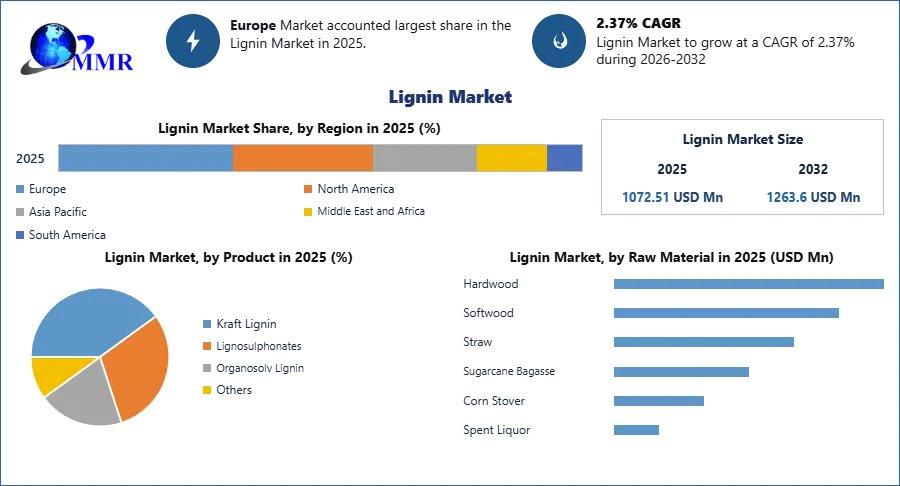
The Lignin Market is entering a period of steady expansion as industries increasingly seek renewable, low-carbon alternatives to petroleum-derived chemicals and materials. According to Maximize Market Research, the Lignin Market was valued at USD 1,072.51 Million in 2025 and is expected to grow at a CAGR of 2.37% from 2026 to 2032, reaching nearly USD 1,263.60 Million by 2032. Lignin, one of the most abundant components of biomass and a major by-product of pulp and biorefinery operations, is gaining importance as manufacturers explore higher-value applications beyond conventional energy recovery.
Market Estimation, Growth Drivers and Opportunities
Market growth is supported by increasing demand for renewable feedstocks, expanding construction activity, rising demand for animal feed, and growing interest in bio-based chemicals and materials. Lignin can function as a dispersant, binder, adhesive component, concrete additive, agricultural input and precursor for advanced carbon materials. Its ability to replace or reduce petroleum-derived ingredients creates opportunities across chemicals, construction, agriculture, automotive, packaging and energy-storage industries.
A major opportunity lies in lignin valorization. Industrial processes generate large volumes of lignin, while only a small proportion is converted into higher-value products. Advances in extraction, purification, fractionation and carbonization can improve material consistency and unlock applications in polymers, resins, activated carbon, carbon fibers, batteries and other advanced materials. Increasing sustainability requirements are also encouraging companies to extend the lifecycle of biomass-derived materials and develop circular production models.
Receive a Free Sample Copy Instantly : https://www.maximizemarketresearch.com/request-sample/13321/
Lignin Market to Reach USD 1,263.60 Million by 2032 as Bio-Based Materials Gain Momentum
The Lignin Market is entering a period of steady expansion as industries increasingly seek renewable, low-carbon alternatives to petroleum-derived chemicals and materials. According to Maximize Market Research, the Lignin Market was valued at USD 1,072.51 Million in 2025 and is expected to grow at a CAGR of 2.37% from 2026 to 2032, reaching nearly USD 1,263.60 Million by 2032. Lignin, one of the most abundant components of biomass and a major by-product of pulp and biorefinery operations, is gaining importance as manufacturers explore higher-value applications beyond conventional energy recovery.
Market Estimation, Growth Drivers and Opportunities
Market growth is supported by increasing demand for renewable feedstocks, expanding construction activity, rising demand for animal feed, and growing interest in bio-based chemicals and materials. Lignin can function as a dispersant, binder, adhesive component, concrete additive, agricultural input and precursor for advanced carbon materials. Its ability to replace or reduce petroleum-derived ingredients creates opportunities across chemicals, construction, agriculture, automotive, packaging and energy-storage industries.
A major opportunity lies in lignin valorization. Industrial processes generate large volumes of lignin, while only a small proportion is converted into higher-value products. Advances in extraction, purification, fractionation and carbonization can improve material consistency and unlock applications in polymers, resins, activated carbon, carbon fibers, batteries and other advanced materials. Increasing sustainability requirements are also encouraging companies to extend the lifecycle of biomass-derived materials and develop circular production models.
Receive a Free Sample Copy Instantly : https://www.maximizemarketresearch.com/request-sample/13321/
Lignin Market Analysis of Emerging Applications and Industry Development
Lignin Market to Reach USD 1,263.60 Million by 2032 as Bio-Based Materials Gain Momentum
The Lignin Market is entering a period of steady expansion as industries increasingly seek renewable, low-carbon alternatives to petroleum-derived chemicals and materials. According to Maximize Market Research, the Lignin Market was valued at USD 1,072.51 Million in 2025 and is expected to grow at a CAGR of 2.37% from 2026 to 2032, reaching nearly USD 1,263.60 Million by 2032. Lignin, one of the most abundant components of biomass and a major by-product of pulp and biorefinery operations, is gaining importance as manufacturers explore higher-value applications beyond conventional energy recovery.
Market Estimation, Growth Drivers and Opportunities
Market growth is supported by increasing demand for renewable feedstocks, expanding construction activity, rising demand for animal feed, and growing interest in bio-based chemicals and materials. Lignin can function as a dispersant, binder, adhesive component, concrete additive, agricultural input and precursor for advanced carbon materials. Its ability to replace or reduce petroleum-derived ingredients creates opportunities across chemicals, construction, agriculture, automotive, packaging and energy-storage industries.
A major opportunity lies in lignin valorization. Industrial processes generate large volumes of lignin, while only a small proportion is converted into higher-value products. Advances in extraction, purification, fractionation and carbonization can improve material consistency and unlock applications in polymers, resins, activated carbon, carbon fibers, batteries and other advanced materials. Increasing sustainability requirements are also encouraging companies to extend the lifecycle of biomass-derived materials and develop circular production models.
Receive a Free Sample Copy Instantly : https://www.maximizemarketresearch.com/request-sample/13321/

 Français
 Arabic