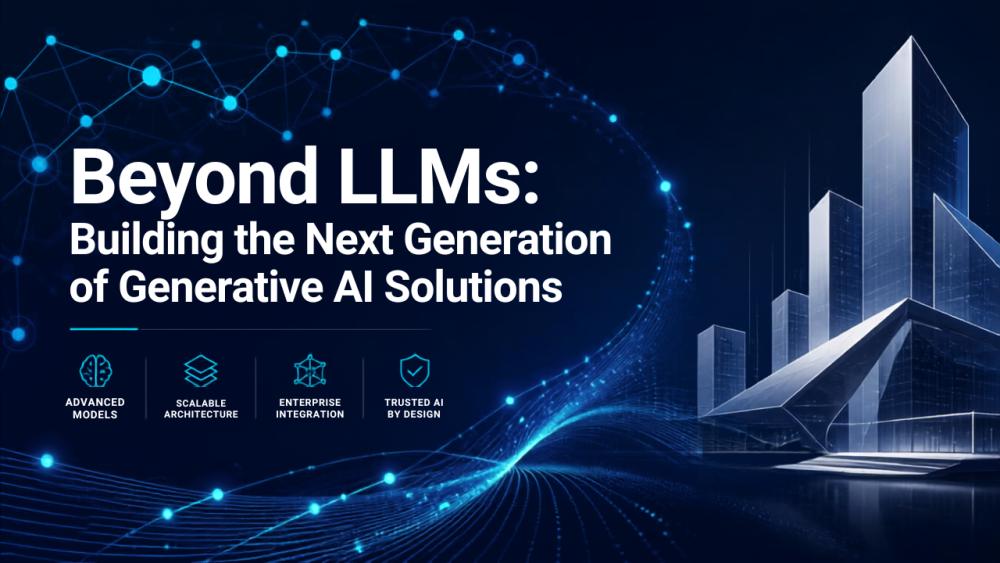
Beyond LLMs: Building the Next Generation of Generative AI Solutions
The first wave of enterprise artificial intelligence was undoubtedly defined by large language models. Chatbots, automated copy generation, and natural language code completion demonstrated text-predictive intelligence. But as corporate deployment matures, engineering leaders are running into distinct walls. Multi-variable supply chain streams, high-resolution diagnostic imaging, dynamic tabular databases, and real-time robotic controls challenge text-only processing. Latency issues, high inference costs, and hallucination risks make standard text models too costly for enterprise applications. To move beyond language models in isolation, we need to develop Generative AI Solutions that incorporate multimodal data, run autonomous action cycles, and run within specialized domain architectures. Developing modern enterprise AI solutions requires moving beyond basic prompt engines to mature, end-to-end system platforms. Why Large Language Models Are Reaching Operational Limits Although LLMs translate text proficiently in an unstructured way, their architecture becomes a bottleneck in operational processes. High Inference Costs and Resource Constraints Running massive parameter models requires significant compute power and continuous GPU allocation. For enterprises scaling high-throughput transaction processing, the cost per query under a massive model architecture quickly erodes margins. Structural Inability to Handle Dynamic Tabular Data Standard text models predict token sequences rather than calculating numerical state transitions. When fed massive relational databases, vector structures, or financial spreadsheets, traditional text models struggle with exact logic, leading to structural inaccuracies or subtle calculation errors. Hallucination Risks in High-Stakes Environments Uncertainty estimation remains a core challenge in pure text models. In fields like clinical diagnostics, risk underwriting, or legal compliance, a probabilistic model guessing the next word without deterministic validation creates unacceptable compliance risk. Core Foundations of Next-Generation AI Architectures Moving beyond pure language models requires a shift to multimodal ai architectures that can perceive, reason, and execute across diverse formats. Multimodal Intelligence Frameworks Instead of using text descriptions for non-text inputs, today’s multimodal systems work directly with raw visual signals, sensor telemetry, videos, and audio frequencies. Multimodal-native systems perform significantly better with complex real-world data. For instance, healthcare platforms processing high-resolution medical scans alongside patient history achieve faster diagnostic throughput when using unified vision-language structures rather than disjointed processing steps. Autonomous Agentic Workflows The evolution from static Q&A systems to multi-agent environments allows AI systems to act independently. Instead of generating a passive response, autonomous agents divide high-level corporate objectives into sequential sub-tasks- Querying internal vector databases and enterprise APIs. Executing automated software testing cycles. Validating output accuracy against business logic rules. Writing results back to enterprise resource planning platforms. Specialized Small Language Models (SLMs) and Edge Architectures Bigger is no longer automatically better. Compact, highly specialized models trained on curated, domain-specific datasets routinely outperform massive foundation models on focused tasks - at a fraction of the computational footprint. Deploying optimized ML solutions at the edge reduces bandwidth dependencies, protects confidential data, and lowers latency for industrial applications. Neuro-Symbolic Integration Integrating neural networks with symbolic logic ensures that deterministic logic is included in artificial intelligence technology. Neural networks handle pattern recognition and intuitive data interpretation, while symbolic logic engines enforce rules, equations, and business requirements to prevent hallucinations in regulated industries. Key Industry Trends Driving System Adoption Corporate real estate, industrial manufacturing, logistics, and software development are aggressively updating their tech stacks to support robust generative AI solutions alongside multi-model platforms. Rise of World Models- Industrial robotics and autonomous logistics rely increasingly on spatial world models that simulate real-world physics and spatial relationships, allowing machines to navigate unpredictable warehouse environments accurately. Hybrid Cloud-to-Edge Orchestration- Enterprise technology teams deploy small localized models directly on field devices while reserving massive cloud infrastructure strictly for heavy periodic retrain cycles. Enterprise Customization via RAG and Graph Databases- Companies are replacing raw model fine-tuning with advanced Retrieval-Augmented Generation (RAG) wired directly into knowledge graphs, ensuring outputs remain grounded in real company data. Industry forecasts indicate that enterprise adoption of task-specific agents and specialized domain models is growing dramatically, with research projecting up to 40% of enterprise applications integrating task-driven AI agents as spending shifts toward targeted, high-efficiency models. Strategic Roadmap for Enterprise Deployment Navigating the transition from basic text tools to robust, scalable generative AI services requires a structured engineering approach. Step 1- Audit Data Pipeline Maturity Before choosing model architectures, ensure internal enterprise data is clean, indexed, and accessible via secure APIs. Disorganized, siloed data degrades even the most advanced system performance. Step 2- Match Business Use Cases to Model Size Avoid using massive models for simple operational tasks. Map each corporate initiative to its precise performance metrics. Use lightweight machine learning solution builds for real-time analytics, and reserve large multimodal models for complex data synthesis. Step 3- Partner with Specialized Engineering Experts Developing bespoke multimodal pipelines, creating secure agentic workflows, and deploying hybrid edge models all need extensive industry knowledge. Working with a skilled AI ML development company will help ensure your system design avoids future architectural changes. Final Words The use of large language models alone is just the beginning of the wider artificial intelligence wave. The future is integrated, multimodal, agentic generative ai solutions ecosystems that seamlessly combine pattern recognition with rigid business logic. Forward-thinking organizations will be able to build scalable digital infrastructure that delivers measurable long-term business value, with a focus on lean model architectures, robust data pipelines and deterministic verification layers.





 English
 Français