PaySocial | Monetize your skills and share your projects

Search

Discover new people, create new connections and make new friends

  • AI in Car Rental Industry: Smarter Fleet, Pricing & Booking


    Artificial intelligence has become an essential tool for revolutionizing various industries, including the car rental industry . From streamlining operations through AI-powered dynamic pricing and predictive maintenance to enhancing customer experience with chatbots, AI technology is driving efficiency and growth across all facets of the car rental business.


    Visit:- https://kuchoriyatechsoft.com/ai-in-car-rental-business
    75 Views
  • No-Code AI Platform Market Future Outlook and Key Growth Drivers

    Global No-Code AI Platform Market to Reach USD 29.54 Billion by 2030, Driven by Growing AI Adoption and Automation Demand

    Market Estimation, Growth Drivers and Opportunities

    The No-Code AI Platform Market was valued at USD 5.07 billion in 2023 and is projected to reach approximately USD 29.54 billion by 2030, registering a CAGR of 28.6% during the forecast period from 2024 to 2030. The market is experiencing significant growth as organizations increasingly adopt artificial intelligence solutions without requiring extensive programming knowledge or specialized technical expertise. No-code AI platforms enable businesses to develop, deploy, and manage AI-powered applications through visual interfaces, drag-and-drop functionalities, pre-built templates, and automated machine learning tools.

    The increasing demand for business process automation, rising adoption of cloud-based technologies, and growing need for faster application development are major factors supporting market expansion. Organizations across banking, financial services, insurance, healthcare, retail, manufacturing, and telecommunications are implementing no-code AI platforms to improve operational efficiency, customer engagement, and decision-making capabilities. Additionally, the shortage of skilled AI professionals and high costs associated with traditional software development are encouraging businesses to adopt accessible AI development solutions.

    Small and medium-sized enterprises represent an important growth opportunity because these platforms reduce development expenses and allow non-technical employees to participate in AI implementation. Advancements in generative AI, natural language processing, predictive analytics, and automated machine learning are further creating opportunities for platform providers. However, data privacy concerns, security vulnerabilities, integration challenges, and limitations in handling complex AI workloads may restrict market adoption.

    United States Market: Latest Trends and Investments in 2025

    The United States remains an important market for no-code AI platforms, supported by strong technology infrastructure, enterprise digital transformation, venture capital activity, and increasing investments in artificial intelligence. During 2025, major technology companies accelerated their investments in AI-powered application development. Microsoft announced an important advancement in Power Apps in July 2025, introducing capabilities that allow users to work with AI agents to generate application code. The expanded preview brought agent-assisted application development closer to enterprise users across North America. This development demonstrates the industry's movement toward natural-language-driven application creation, combining AI-powered development with enterprise security and governance. Growing adoption of generative AI, cloud infrastructure, and automated business workflows is expected to strengthen demand across American enterprises, particularly in financial services, healthcare, retail, and IT.

    Get Your Free Sample Report Link : https://www.maximizemarketresearch.com/request-sample/213702/

    Market Segmentation: Largest Market Shares

    According to the report, the No-Code AI Platform Market is segmented by component, deployment, technology, organization size, industry, and region.

    By Technology: Natural Language Processing (NLP) dominated the market in 2023, accounting for over 47% of global revenue. Its leadership is attributed to increasing applications in chatbots, sentiment analysis, language translation, and automated customer communication. NLP allows users to develop intelligent applications using everyday language without requiring advanced programming expertise.

    By Industry: IT and Telecommunications held the largest revenue share of 22% in 2023. Increasing requirements for customer support automation, network optimization, operational efficiency, and data analysis are supporting segment leadership.

    By Region: North America dominated the global market in 2023, accounting for over 39% of total revenue, supported by advanced AI infrastructure, technology investments, and strong research and development capabilities.
    Request Sample
    for Request Sample fill the form
    197 Views
  • https://m2squareconsultancy.com/reports/healthcare-chatbots-market
    M2SQUARECONSULTANCY.COM
    Healthcare Chatbots Market Size, Growth, Forecasts to 2034
    The Global Healthcare Chatbots Market Size is expected to grow from USD 2.85 Billion in 2026 to USD 16.64 Billion by 2034, registering a CAGR of 24.8%
    34 Views
  • Banking System Software Market Growth Trends and Development Analysis

    Banking System Software Market to Reach US$ 60.18 Billion by 2034 as Banks Accelerate Digital Transformation

    The Banking System Software Market is entering a new phase of technology-led transformation as banks increasingly modernize core infrastructure, expand digital banking services, strengthen cybersecurity, and adopt artificial intelligence. According to Maximize Market Research, the Banking System Software Market is expected to reach US$ 60.18 billion by 2034, expanding at a CAGR of 5.98% during the forecast period. The market was valued at approximately US$ 35.68 billion in 2025, highlighting the substantial investment opportunity emerging across banking technology.

    Market Estimation, Growth Drivers and Opportunities

    The rapid adoption of online and mobile banking is a major factor supporting the expansion of banking system software. Customers increasingly expect real-time account access, digital payments, personalized financial services, remote onboarding, and seamless transactions across multiple channels. Banks are therefore replacing fragmented legacy platforms with integrated, cloud-enabled and API-driven systems.

    The growing penetration of smartphones and internet banking is further increasing demand for banking software capable of supporting high transaction volumes and omnichannel customer experiences. At the same time, financial institutions are investing in automation, business intelligence, information security, risk management, fraud detection and regulatory compliance.

    Artificial intelligence and generative AI represent another significant opportunity. AI-enabled banking platforms can automate repetitive processes, improve customer service, identify suspicious transactions, support credit decisions and generate actionable insights from large volumes of financial data. Cloud migration, open banking, fintech partnerships and digital payment modernization are expected to create additional opportunities for software providers through 2034.

    Get a Sample Insight Report Now : https://www.maximizemarketresearch.com/request-sample/16011/

    U.S. Market: AI, Security and Core Modernization Drive Investment

    The United States remains a key market for banking system software, supported by a mature financial sector and high adoption of digital banking. In 2025, U.S. banks increasingly balanced investments in cybersecurity, fraud prevention, digital channels, core modernization and generative AI. A KPMG survey of 200 U.S. banking executives found that 89% prioritized security and fraud prevention for the coming year, while 67% expected enterprise GenAI enablement to become a priority over the following three years. Online banking, mobile banking and chatbots were among the leading digital-channel investment areas.

    Large U.S. banks are also increasing AI deployment across operations. Bank of America, for example, reported substantial technology investment and continued development of AI capabilities for research, customer service, fraud detection and employee productivity. Federal regulators have simultaneously emphasized responsible AI adoption, cybersecurity, data governance and risk management, creating demand for secure and compliant banking software.
    345 Views
  • Cheapest Flights London
    Global Dreams Fly Limited was founded in London in 2014 by two former high-street travel agents who felt UK travellers deserved better than faceless search results and hidden fees. We started as a small phone-booking service and have grown into a leading UK online travel agency, still booking package holidays with the same personal approach for thousands of travellers a year.

    Over a decade later, we're still based at the same East London office on High Street North, now with a team of specialist agents covering hotels, flights and tailor-made holidays across more than 60 countries.

    We answer the phone

    No call centre queues or chatbots for complex requests — you speak with the agent who booked your trip, not a rotating support desk.

    We compare, not just resell

    Our agents check rates across dozens of hotel and airline partners before recommending anything, and we'll tell you if a deal isn't worth it.

    We stay reachable after booking

    Flight changes, hotel amendments and last-minute questions go to the same team that arranged your trip in the first place.

    Source: https://globaldreamsfly.com/hotels
    197 Views
  • AI & ML Services to Power Intelligent Business Solutions

    Seasia Infotech provides end-to-end AI and ML Services covering AI/ML consulting, machine learning models, natural language processing, computer vision, predictive analytics, chatbots, AI integration, and custom AI software development. Turn business data and challenges into intelligent technology solutions.

    Read more: https://www.seasiainfotech.com/ai-ml-services

    #AIConsultingServices #AIandMLServices #CustomAISolutions #MachineLearningDevelopment #GenerativeAI #AgenticAI #SeasiaInfotech #EnterpriseAI
    WWW.SEASIAINFOTECH.COM
    AI/ML Services & Development Company | Seasia Infotech
    Seasia Infotech delivers AI/ML services, custom AI solutions, machine learning, generative AI, and intelligent automation to help businesses innovate and grow.
    746 Views
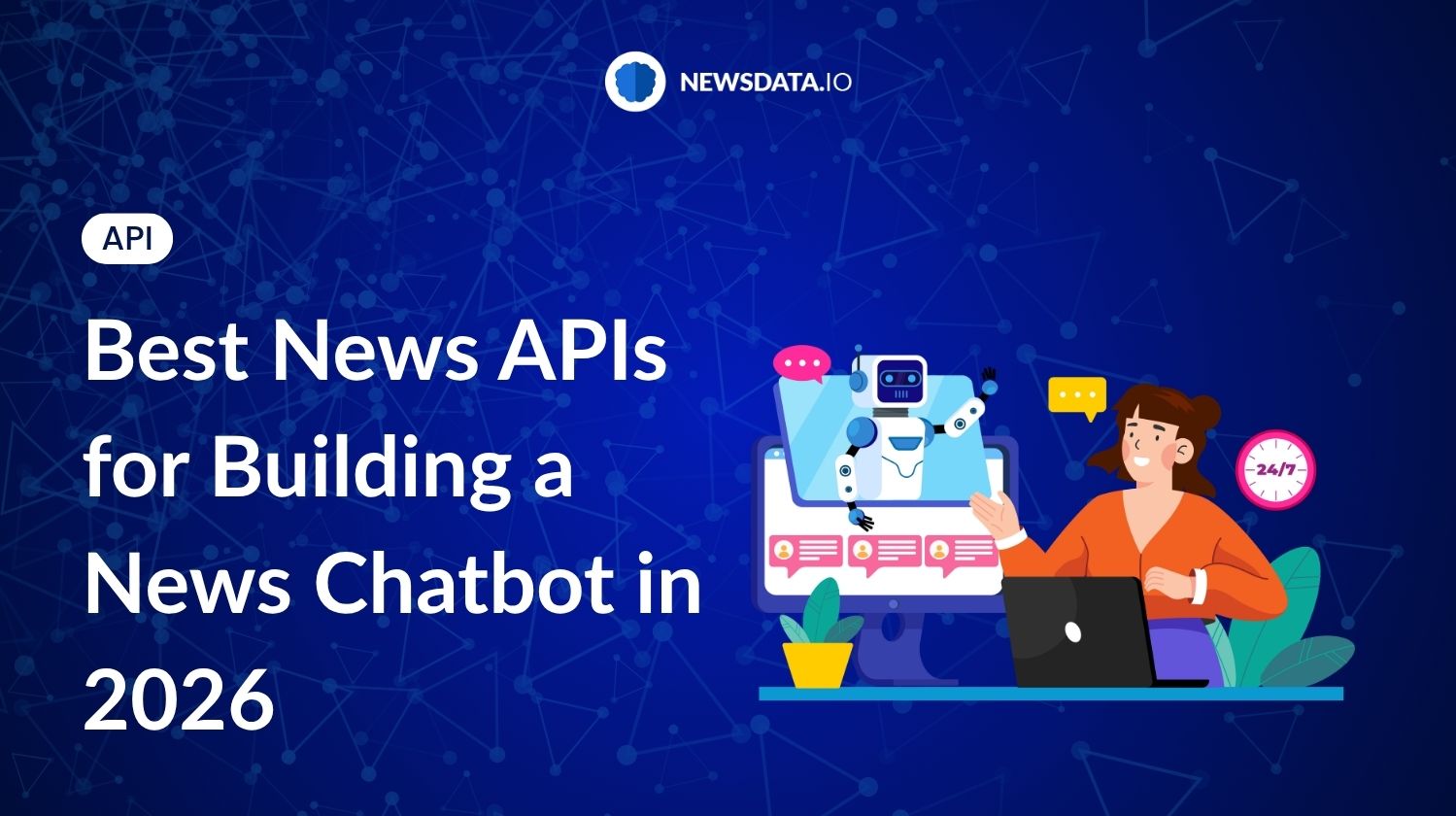
  • Building a news chatbot requires more than a powerful AI model. It also needs fresh, structured information. This guide explains how a News API can provide real-time news, historical context, multiple languages, sources, categories, and filters to help developers build more useful and current AI-powered news chatbots.

    Click here for more info: https://newsdata.io/blog/news-api-for-news-chatbot/

    #News #AI #USA #Developers #Information
    NEWSDATA.IO
    Best News APIs for Building a News Chatbot in 2026 - Newsdata.io - Stay Updated with the Latest News API Trends
    Looking for the best News API for AI News Chatbot integration? Explore how NewsData.io can be the ideal choice in 2026 with real-time data.
    Like
    1
    384 Views

  • Build to intelligent customer support and business automation solutions with AI Chatbot Development. Create customized chatbots with natural language processing, automated responses, business integrations and 24/7 user assistance to improve digital customer experiences.

    Visit Us >> https://www.touchcrypto.org/chatbot-development-company

    Any Queries? Talk to Our Experts:
    Phone: +91 81485 41753
    WhatsApp: https://wa.me/+918148541753
    Gmail: business@touchcrypto.org
    Telegram: https://telegram.me/touchcrypto1

    #AIChatbotDevelopment #AIDevelopment #ChatbotDevelopment #ArtificialIntelligence #BlockchainDevelopment #Web3Development #AI #MachineLearning #Web3 #Blockchain
    961 Views
  • Your Trusted Branding and Digital Agency

    We take pride in being your trusted branding and digital agency, delivering innovative brand and digital solutions that drive business growth. Our expertise goes beyond traditional branding; we offer comprehensive enterprise branding strategies, digital branding services, and brand identity agency solutions that empower your business to connect with the right audience and stand out in a competitive market.

    Understanding the needs of modern businesses, we specialize in full-service strategies as a creative branding agency and full service digital agency, ensuring your brand achieves measurable results across all digital channels. To keep your business ahead of the curve, we provide advanced AI chatbot integration services and business technology solutions that enhance online engagement, streamline communication, and create personalized experiences for your customers. With a focus on creativity, strategy, and long-term growth, Feynix Solution is your partner in building impactful brand experiences.

    As a technology driven agency and brand strategy agency, we combine innovative design, marketing expertise, enterprise branding, and intelligent technology. Including AI chatbots, to deliver solutions that resonate with your audience and foster lasting connections.
    FEYNIXSOLUTION.COM
    Feynix Solution | Trusted Leading IT Company Worldwide
    Choose Feynix Solution for innovative software development, AI, cloud computing, web & mobile apps, and scalable IT solutions for every business.
    377 Views
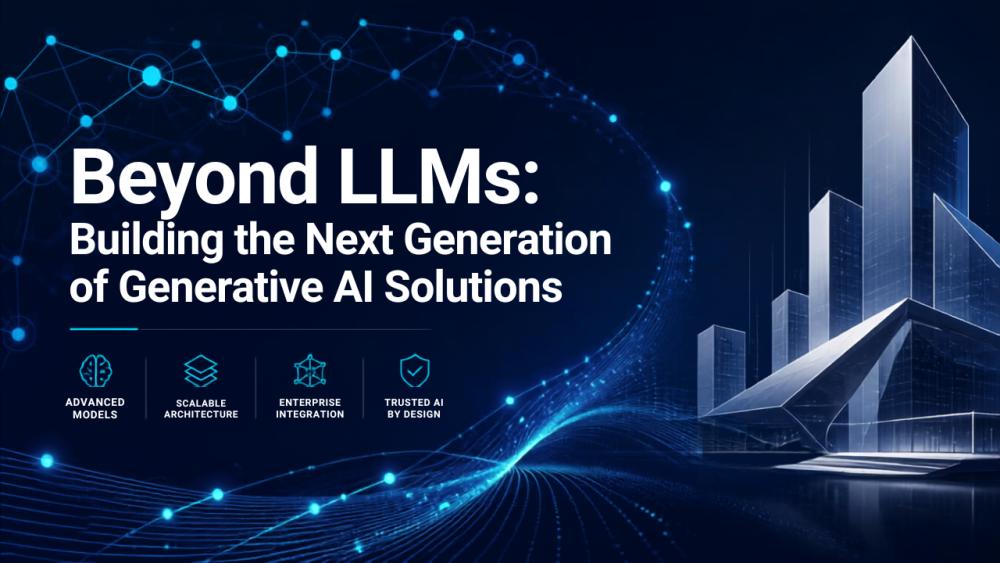
  • LLMs have transformed AI, but they are only part of the bigger picture. New architectures and AI approaches are opening the door to more powerful enterprise applications. Explore what comes beyond LLMs and how organizations can prepare for the next phase of generative AI. Read the full blog to learn more.

    Click here: https://my.ai.se/resources/beyond-llms-building-the-next-generation-of-generative-ai-solutions

    #GenerativeAI #AI #LLMs #EnterpriseAI #AIInnovation #FutureTech
    MY.AI.SE
    Beyond LLMs: Building the Next Generation of Generative AI Solutions
    The first wave of enterprise artificial intelligence was undoubtedly defined by large language models. Chatbots, automated copy generation, and natural language code completion demonstrated text-predictive intelligence. But as corporate deployment matures, engineering leaders are running into distinct walls. Multi-variable supply chain streams, high-resolution diagnostic imaging, dynamic tabular databases, and real-time robotic controls challenge text-only processing. Latency issues, high inference costs, and hallucination risks make standard text models too costly for enterprise applications. To move beyond language models in isolation, we need to develop Generative AI Solutions that incorporate multimodal data, run autonomous action cycles, and run within specialized domain architectures. Developing modern enterprise AI solutions requires moving beyond basic prompt engines to mature, end-to-end system platforms. Why Large Language Models Are Reaching Operational Limits Although LLMs translate text proficiently in an unstructured way, their architecture becomes a bottleneck in operational processes. High Inference Costs and Resource Constraints Running massive parameter models requires significant compute power and continuous GPU allocation. For enterprises scaling high-throughput transaction processing, the cost per query under a massive model architecture quickly erodes margins. Structural Inability to Handle Dynamic Tabular Data Standard text models predict token sequences rather than calculating numerical state transitions. When fed massive relational databases, vector structures, or financial spreadsheets, traditional text models struggle with exact logic, leading to structural inaccuracies or subtle calculation errors. Hallucination Risks in High-Stakes Environments Uncertainty estimation remains a core challenge in pure text models. In fields like clinical diagnostics, risk underwriting, or legal compliance, a probabilistic model guessing the next word without deterministic validation creates unacceptable compliance risk. Core Foundations of Next-Generation AI Architectures Moving beyond pure language models requires a shift to multimodal ai architectures that can perceive, reason, and execute across diverse formats. Multimodal Intelligence Frameworks Instead of using text descriptions for non-text inputs, today’s multimodal systems work directly with raw visual signals, sensor telemetry, videos, and audio frequencies. Multimodal-native systems perform significantly better with complex real-world data. For instance, healthcare platforms processing high-resolution medical scans alongside patient history achieve faster diagnostic throughput when using unified vision-language structures rather than disjointed processing steps. Autonomous Agentic Workflows The evolution from static Q&A systems to multi-agent environments allows AI systems to act independently. Instead of generating a passive response, autonomous agents divide high-level corporate objectives into sequential sub-tasks- Querying internal vector databases and enterprise APIs. Executing automated software testing cycles. Validating output accuracy against business logic rules. Writing results back to enterprise resource planning platforms. Specialized Small Language Models (SLMs) and Edge Architectures Bigger is no longer automatically better. Compact, highly specialized models trained on curated, domain-specific datasets routinely outperform massive foundation models on focused tasks - at a fraction of the computational footprint. Deploying optimized ML solutions at the edge reduces bandwidth dependencies, protects confidential data, and lowers latency for industrial applications. Neuro-Symbolic Integration Integrating neural networks with symbolic logic ensures that deterministic logic is included in artificial intelligence technology. Neural networks handle pattern recognition and intuitive data interpretation, while symbolic logic engines enforce rules, equations, and business requirements to prevent hallucinations in regulated industries. Key Industry Trends Driving System Adoption Corporate real estate, industrial manufacturing, logistics, and software development are aggressively updating their tech stacks to support robust generative AI solutions alongside multi-model platforms. Rise of World Models- Industrial robotics and autonomous logistics rely increasingly on spatial world models that simulate real-world physics and spatial relationships, allowing machines to navigate unpredictable warehouse environments accurately. Hybrid Cloud-to-Edge Orchestration- Enterprise technology teams deploy small localized models directly on field devices while reserving massive cloud infrastructure strictly for heavy periodic retrain cycles. Enterprise Customization via RAG and Graph Databases- Companies are replacing raw model fine-tuning with advanced Retrieval-Augmented Generation (RAG) wired directly into knowledge graphs, ensuring outputs remain grounded in real company data. Industry forecasts indicate that enterprise adoption of task-specific agents and specialized domain models is growing dramatically, with research projecting up to 40% of enterprise applications integrating task-driven AI agents as spending shifts toward targeted, high-efficiency models. Strategic Roadmap for Enterprise Deployment Navigating the transition from basic text tools to robust, scalable generative AI services requires a structured engineering approach. Step 1- Audit Data Pipeline Maturity Before choosing model architectures, ensure internal enterprise data is clean, indexed, and accessible via secure APIs. Disorganized, siloed data degrades even the most advanced system performance. Step 2- Match Business Use Cases to Model Size Avoid using massive models for simple operational tasks. Map each corporate initiative to its precise performance metrics. Use lightweight machine learning solution builds for real-time analytics, and reserve large multimodal models for complex data synthesis. Step 3- Partner with Specialized Engineering Experts Developing bespoke multimodal pipelines, creating secure agentic workflows, and deploying hybrid edge models all need extensive industry knowledge. Working with a skilled AI ML development company will help ensure your system design avoids future architectural changes. Final Words The use of large language models alone is just the beginning of the wider artificial intelligence wave. The future is integrated, multimodal, agentic generative ai solutions ecosystems that seamlessly combine pattern recognition with rigid business logic. Forward-thinking organizations will be able to build scalable digital infrastructure that delivers measurable long-term business value, with a focus on lean model architectures, robust data pipelines and deterministic verification layers.
    470 Views
More Results
© 2026 PaySocial | Monetize your skills and share your projects