• Python Full Stack Course in Hyderabad Digital New
    €272.84
    In stock
    AimNxt Technologies LLP, KPHB 5th Phase, Hyderabad, 500085
    0 Reviews
    Learn Python programming with AIMNXT’s expert-led course training in Kukatpally, Hyderabad. Gain practical skills in data science, web development, and automation. EMI Available for easy installment payments.
    Learn Python programming with AIMNXT’s expert-led course training in Kukatpally, Hyderabad. Gain practical skills in data science, web development, and automation. EMI Available for easy installment payments.
    0 Comments 0 Shares 39 Views 0 Reviews
  • Domain-Specific LLM Market Size, Share & Growth Analysis 2035


    The Global Domain-Specific LLM Market is projected to reach USD 9.4 billion in 2026 and expand to USD 172.9 billion by 2035, growing at a 38.3% CAGR. Growth is driven by demand for industry-specific AI, enterprise automation, fine-tuning, retrieval-augmented generation, secure deployments, and multimodal capabilities. North America is expected to lead with a 38.0% market share in 2026 globally overall.


    Learn more: https://dimensionmarketresearch.com/report/domain-specific-llm-market/
    Domain-Specific LLM Market Size, Share & Growth Analysis 2035 The Global Domain-Specific LLM Market is projected to reach USD 9.4 billion in 2026 and expand to USD 172.9 billion by 2035, growing at a 38.3% CAGR. Growth is driven by demand for industry-specific AI, enterprise automation, fine-tuning, retrieval-augmented generation, secure deployments, and multimodal capabilities. North America is expected to lead with a 38.0% market share in 2026 globally overall. Learn more: https://dimensionmarketresearch.com/report/domain-specific-llm-market/
    DIMENSIONMARKETRESEARCH.COM
    Domain Specific LLM Market Size, Share | CAGR of 38.3%
    The Global Domain Specific LLM Market is valued at USD 9.4 billion in 2026, growing at 38.3% CAGR to USD 172.9 billion by 2035. Explore key trends.
    0 Comments 0 Shares 82 Views 0 Reviews
  • ChemHub – Advanced Chemical Solutions for Modern Industries


    ChemHub, Inc. provides custom chemical synthesis, specialty chemical manufacturing, process development, and research support from Sayreville, New Jersey. Its expertise covers fine chemicals, pharmaceuticals, flavor and fragrance ingredients, pheromone chemistry, chiral chemistry, and toll manufacturing. ChemHub supports projects from research and development to scalable production, offering flexible solutions for specialized chemical requirements.


    🌐 www.chemhub.com | +1 (732) 721-4700


    #chemhub #chemicalmanufacturing #customsynthesis #specialtychemicals #finechemicals #tollmanufacturing #chemicalresearch #chemicalmanufacturerusa
    ChemHub – Advanced Chemical Solutions for Modern Industries ChemHub, Inc. provides custom chemical synthesis, specialty chemical manufacturing, process development, and research support from Sayreville, New Jersey. Its expertise covers fine chemicals, pharmaceuticals, flavor and fragrance ingredients, pheromone chemistry, chiral chemistry, and toll manufacturing. ChemHub supports projects from research and development to scalable production, offering flexible solutions for specialized chemical requirements. 🌐 www.chemhub.com | +1 (732) 721-4700 #chemhub #chemicalmanufacturing #customsynthesis #specialtychemicals #finechemicals #tollmanufacturing #chemicalresearch #chemicalmanufacturerusa
    ChemHub
    Looking for Reliable outsourcing partner for Flavor-Fragrance Ingredients, Pheromone ingredients and fine chemicals in New Jersey, USA? ChemHub is pharmaceuticals company in new jersey USA.
    0 Comments 0 Shares 412 Views 0 Reviews
  • Janitor AI: Complete Guide to AI Characters, JLLM, Janitor+ and More


    Discover everything you need to know about Janitor AI, a popular platform for interactive AI character conversations. Learn how JLLM, Janitor+, Router, DeepSeek, and OpenRouter work, along with features such as talking agents and built-in AI. This guide also covers Janitor AI login, safety considerations, common features, and popular alternatives, helping both new and existing users understand the platform and make better use of its AI-powered conversations.
    https://jarvisreach.io/blog/what-is-janitor-ai/
    Janitor AI: Complete Guide to AI Characters, JLLM, Janitor+ and More Discover everything you need to know about Janitor AI, a popular platform for interactive AI character conversations. Learn how JLLM, Janitor+, Router, DeepSeek, and OpenRouter work, along with features such as talking agents and built-in AI. This guide also covers Janitor AI login, safety considerations, common features, and popular alternatives, helping both new and existing users understand the platform and make better use of its AI-powered conversations. https://jarvisreach.io/blog/what-is-janitor-ai/
    JARVISREACH.IO
    What is Janitor AI? Safety, Tips and Fixing Common Errors
    Janitor AI has changed a lot in 2026. From Janitor+ to smarter memory and new AI models, here is what you need to know before using it.
    0 Comments 0 Shares 51 Views 0 Reviews
  • LLMs have transformed AI, but they are only part of the bigger picture. New architectures and AI approaches are opening the door to more powerful enterprise applications. Explore what comes beyond LLMs and how organizations can prepare for the next phase of generative AI. Read the full blog to learn more.


    Click here: https://my.ai.se/resources/beyond-llms-building-the-next-generation-of-generative-ai-solutions


    #GenerativeAI #AI #LLMs #EnterpriseAI #AIInnovation #FutureTech
    LLMs have transformed AI, but they are only part of the bigger picture. New architectures and AI approaches are opening the door to more powerful enterprise applications. Explore what comes beyond LLMs and how organizations can prepare for the next phase of generative AI. Read the full blog to learn more. Click here: https://my.ai.se/resources/beyond-llms-building-the-next-generation-of-generative-ai-solutions #GenerativeAI #AI #LLMs #EnterpriseAI #AIInnovation #FutureTech
    MY.AI.SE
    Beyond LLMs: Building the Next Generation of Generative AI Solutions
    The first wave of enterprise artificial intelligence was undoubtedly defined by large language models. Chatbots, automated copy generation, and natural language code completion demonstrated text-predictive intelligence. But as corporate deployment matures, engineering leaders are running into distinct walls. Multi-variable supply chain streams, high-resolution diagnostic imaging, dynamic tabular databases, and real-time robotic controls challenge text-only processing. Latency issues, high inference costs, and hallucination risks make standard text models too costly for enterprise applications. To move beyond language models in isolation, we need to develop Generative AI Solutions that incorporate multimodal data, run autonomous action cycles, and run within specialized domain architectures. Developing modern enterprise AI solutions requires moving beyond basic prompt engines to mature, end-to-end system platforms. Why Large Language Models Are Reaching Operational Limits Although LLMs translate text proficiently in an unstructured way, their architecture becomes a bottleneck in operational processes. High Inference Costs and Resource Constraints Running massive parameter models requires significant compute power and continuous GPU allocation. For enterprises scaling high-throughput transaction processing, the cost per query under a massive model architecture quickly erodes margins. Structural Inability to Handle Dynamic Tabular Data Standard text models predict token sequences rather than calculating numerical state transitions. When fed massive relational databases, vector structures, or financial spreadsheets, traditional text models struggle with exact logic, leading to structural inaccuracies or subtle calculation errors. Hallucination Risks in High-Stakes Environments Uncertainty estimation remains a core challenge in pure text models. In fields like clinical diagnostics, risk underwriting, or legal compliance, a probabilistic model guessing the next word without deterministic validation creates unacceptable compliance risk. Core Foundations of Next-Generation AI Architectures Moving beyond pure language models requires a shift to multimodal ai architectures that can perceive, reason, and execute across diverse formats. Multimodal Intelligence Frameworks Instead of using text descriptions for non-text inputs, today’s multimodal systems work directly with raw visual signals, sensor telemetry, videos, and audio frequencies. Multimodal-native systems perform significantly better with complex real-world data. For instance, healthcare platforms processing high-resolution medical scans alongside patient history achieve faster diagnostic throughput when using unified vision-language structures rather than disjointed processing steps. Autonomous Agentic Workflows The evolution from static Q&A systems to multi-agent environments allows AI systems to act independently. Instead of generating a passive response, autonomous agents divide high-level corporate objectives into sequential sub-tasks- Querying internal vector databases and enterprise APIs. Executing automated software testing cycles. Validating output accuracy against business logic rules. Writing results back to enterprise resource planning platforms. Specialized Small Language Models (SLMs) and Edge Architectures Bigger is no longer automatically better. Compact, highly specialized models trained on curated, domain-specific datasets routinely outperform massive foundation models on focused tasks - at a fraction of the computational footprint. Deploying optimized ML solutions at the edge reduces bandwidth dependencies, protects confidential data, and lowers latency for industrial applications. Neuro-Symbolic Integration Integrating neural networks with symbolic logic ensures that deterministic logic is included in artificial intelligence technology. Neural networks handle pattern recognition and intuitive data interpretation, while symbolic logic engines enforce rules, equations, and business requirements to prevent hallucinations in regulated industries. Key Industry Trends Driving System Adoption Corporate real estate, industrial manufacturing, logistics, and software development are aggressively updating their tech stacks to support robust generative AI solutions alongside multi-model platforms. Rise of World Models- Industrial robotics and autonomous logistics rely increasingly on spatial world models that simulate real-world physics and spatial relationships, allowing machines to navigate unpredictable warehouse environments accurately. Hybrid Cloud-to-Edge Orchestration- Enterprise technology teams deploy small localized models directly on field devices while reserving massive cloud infrastructure strictly for heavy periodic retrain cycles. Enterprise Customization via RAG and Graph Databases- Companies are replacing raw model fine-tuning with advanced Retrieval-Augmented Generation (RAG) wired directly into knowledge graphs, ensuring outputs remain grounded in real company data. Industry forecasts indicate that enterprise adoption of task-specific agents and specialized domain models is growing dramatically, with research projecting up to 40% of enterprise applications integrating task-driven AI agents as spending shifts toward targeted, high-efficiency models. Strategic Roadmap for Enterprise Deployment Navigating the transition from basic text tools to robust, scalable generative AI services requires a structured engineering approach. Step 1- Audit Data Pipeline Maturity Before choosing model architectures, ensure internal enterprise data is clean, indexed, and accessible via secure APIs. Disorganized, siloed data degrades even the most advanced system performance. Step 2- Match Business Use Cases to Model Size Avoid using massive models for simple operational tasks. Map each corporate initiative to its precise performance metrics. Use lightweight machine learning solution builds for real-time analytics, and reserve large multimodal models for complex data synthesis. Step 3- Partner with Specialized Engineering Experts Developing bespoke multimodal pipelines, creating secure agentic workflows, and deploying hybrid edge models all need extensive industry knowledge. Working with a skilled AI ML development company will help ensure your system design avoids future architectural changes. Final Words The use of large language models alone is just the beginning of the wider artificial intelligence wave. The future is integrated, multimodal, agentic generative ai solutions ecosystems that seamlessly combine pattern recognition with rigid business logic. Forward-thinking organizations will be able to build scalable digital infrastructure that delivers measurable long-term business value, with a focus on lean model architectures, robust data pipelines and deterministic verification layers.
    0 Comments 0 Shares 176 Views 0 Reviews
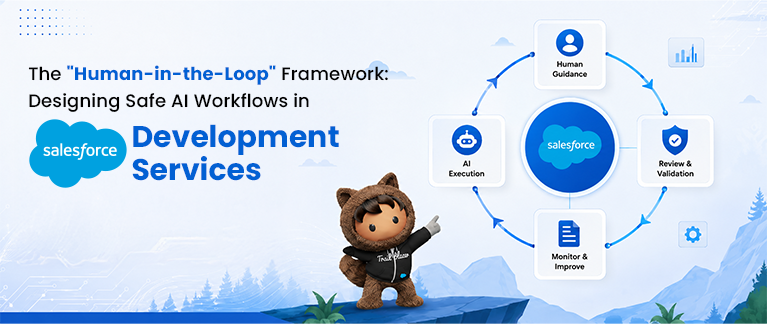
  • This details a significant method in which AI is transforming business automation, although on its own, the technology sins at cost-consuming blunders, also called hallucinations. Companies utilizing Salesforce and making great use of Salesforce development services would need to overcome the data security issue while ensuring maximum automation work effectiveness.


    Human-in-the-loop technology can play a helpful role. This blog shares techniques of creating a swift yet secure system working in Salesforce while monitoring data through human involvement and developing new business activities.


    Understanding of the Human-in-the-loop Framework
    The term ‘Human-in-the-loop’ is related to Artificial Intelligence applications that apply an algorithm that transforms data and produces outcomes, under human supervision.


    Research has demonstrated that the implementation of HITL in generative AI businesses may help to decrease errors up to 40% of the total work done. Moreover, it ensures compliance, correctness, and voice suitability of a working CRM.


    Essential Steps to Build Safe Artificial Intelligence Workflows with a Salesforce Development Company
    1. Determine Important Trigger Points
    Recognize AI processes that require verification from humans. If you’re taking any type of risk, including sending a message to a valuable customer or modifying the fields in an agreement, freeze it constantly until you receive confirmation.


    2. Include Approval Screens in Salesforce Interface
    Create user-friendly validation screens using the Salesforce Flow Builder. When the response is generated by either Einstein or an external LLM, demonstrate it within the console that is in front of the application user so that you can check the process quickly.


    3. Create Feedback Loops
    Let users signal false AI answers. By saving this info in Salesforce, you can modify your prompts, which mean continuous enhancement of the model quality with assistance from your Salesforce Development Company.


    Implementation Toolkit: Workflow Risk Checklist


    List and label all tasks that can be automated that have a high liability.
    Set up Flow Builder so that AI outputs go to a review queue.
    Configure permissions based on the roles.
    Quick expert tip: The HITL trend is going up! Assign high-complexity AI output to senior team members without having to do manual selection using Salesforce Omni-Channel routing, and have junior team members validate routine items.


    Internal Resources


    See our comprehensive Salesforce development services and tailor your automation pipelines according to your requirements.
    Discover how a dedicated Salesforce Development company can help you protect your data layer in your enterprise.
    Looking for the Right Salesforce Development Company in “Human-in-the-Loop” Framework?
    Safe deployment of AI requires human judgment to be at the core of your strategy. A human-in-the-loop approach ensures your CRM data integrity while still maximizing automation. However, you need experts’ assistance to implement this approach effectively.


    Tech9logy Creators is the right choice for you. We are a Registered Salesforce Development Company with over 12 years of experience. Our certified team of developers has extensive knowledge about different Salesforce clouds and provides you with the best-in-class integration solutions. Our dedicated Salesforce experts help you bring the best out of your CRM and ensure your business operates at its highest potential.
    Learn more: https://tech9logy.com/our-blog/the-human-in-the-loop-framework-design-in-salesforce-development-services/
    This details a significant method in which AI is transforming business automation, although on its own, the technology sins at cost-consuming blunders, also called hallucinations. Companies utilizing Salesforce and making great use of Salesforce development services would need to overcome the data security issue while ensuring maximum automation work effectiveness. Human-in-the-loop technology can play a helpful role. This blog shares techniques of creating a swift yet secure system working in Salesforce while monitoring data through human involvement and developing new business activities. Understanding of the Human-in-the-loop Framework The term ‘Human-in-the-loop’ is related to Artificial Intelligence applications that apply an algorithm that transforms data and produces outcomes, under human supervision. Research has demonstrated that the implementation of HITL in generative AI businesses may help to decrease errors up to 40% of the total work done. Moreover, it ensures compliance, correctness, and voice suitability of a working CRM. Essential Steps to Build Safe Artificial Intelligence Workflows with a Salesforce Development Company 1. Determine Important Trigger Points Recognize AI processes that require verification from humans. If you’re taking any type of risk, including sending a message to a valuable customer or modifying the fields in an agreement, freeze it constantly until you receive confirmation. 2. Include Approval Screens in Salesforce Interface Create user-friendly validation screens using the Salesforce Flow Builder. When the response is generated by either Einstein or an external LLM, demonstrate it within the console that is in front of the application user so that you can check the process quickly. 3. Create Feedback Loops Let users signal false AI answers. By saving this info in Salesforce, you can modify your prompts, which mean continuous enhancement of the model quality with assistance from your Salesforce Development Company. Implementation Toolkit: Workflow Risk Checklist List and label all tasks that can be automated that have a high liability. Set up Flow Builder so that AI outputs go to a review queue. Configure permissions based on the roles. Quick expert tip: The HITL trend is going up! Assign high-complexity AI output to senior team members without having to do manual selection using Salesforce Omni-Channel routing, and have junior team members validate routine items. Internal Resources See our comprehensive Salesforce development services and tailor your automation pipelines according to your requirements. Discover how a dedicated Salesforce Development company can help you protect your data layer in your enterprise. Looking for the Right Salesforce Development Company in “Human-in-the-Loop” Framework? Safe deployment of AI requires human judgment to be at the core of your strategy. A human-in-the-loop approach ensures your CRM data integrity while still maximizing automation. However, you need experts’ assistance to implement this approach effectively. Tech9logy Creators is the right choice for you. We are a Registered Salesforce Development Company with over 12 years of experience. Our certified team of developers has extensive knowledge about different Salesforce clouds and provides you with the best-in-class integration solutions. Our dedicated Salesforce experts help you bring the best out of your CRM and ensure your business operates at its highest potential. Learn more: https://tech9logy.com/our-blog/the-human-in-the-loop-framework-design-in-salesforce-development-services/
    TECH9LOGY.COM
    The “Human-in-the-Loop” Framework: Designing Safe AI Workflows in Salesforce Development Services
    Learn how Salesforce development services use Human-in-the-Loop AI to build secure workflows. Partner with a Salesforce Development Company.
    0 Comments 0 Shares 289 Views 0 Reviews
  • Zipprr AI Chat Software – Ready-Made GPT-4 & Claude AI Chat Platform for Entrepreneurs – $490
    Why limit your AI product to one model? Zipprr AI Chat Software supports GPT-4, Claude, Gemini, and open-source LLMs so your users get the best answers every time. Entrepreneurs can launch a multi-model AI chat platform with custom personas, chat history, file uploads, and export options. At $490, it's the most affordable way to enter the booming AI SaaS market with an enterprise-grade product.
    For more details: https://zipprr.com/ai-chat/
    WhatsApp: http://wa.me/919789308131
    #GPT4 #ClaudeAI #GeminiAI #MultiModelAI #AIChatSoftware #Zipprr #Entrepreneur #AISaaS #LLMPlatform #AIStartup
    Zipprr AI Chat Software – Ready-Made GPT-4 & Claude AI Chat Platform for Entrepreneurs – $490 Why limit your AI product to one model? Zipprr AI Chat Software supports GPT-4, Claude, Gemini, and open-source LLMs so your users get the best answers every time. Entrepreneurs can launch a multi-model AI chat platform with custom personas, chat history, file uploads, and export options. At $490, it's the most affordable way to enter the booming AI SaaS market with an enterprise-grade product. For more details: https://zipprr.com/ai-chat/ WhatsApp: http://wa.me/919789308131 #GPT4 #ClaudeAI #GeminiAI #MultiModelAI #AIChatSoftware #Zipprr #Entrepreneur #AISaaS #LLMPlatform #AIStartup
    ZIPPRR.COM
    AI Chat
    AIchat is self-hostable, white-label AI chat software you can add to any website in one line of code. Grounded, cited answers, live human takeover, lead capture, and built-in billing — the AI chat software you own.
    0 Comments 0 Shares 443 Views 0 Reviews
  • The Future of Carpet Recycling: Trends, Innovations, and Opportunities to 2033


    The carpet recycling market is on the cusp of a significant transformation, driven by emerging trends, innovations, and technological advancements. To stay ahead of the curve, it's essential to understand the future outlook and opportunities in this market. Explore our report on Carpet Recycling for in-depth analysis and future insights.


    📊 Preview the Future with a Free Sample Report: https://sectordatainsights.com/report/carpet-recycling-2095/sample-report


    Emerging Trends and Technological Disruptions
    The carpet recycling market is expected to witness significant technological disruptions, driven by advancements in mechanical and chemical recycling processes. The use of artificial intelligence, machine learning, and the Internet of Things (IoT) is expected to improve the efficiency and effectiveness of recycling processes. Additionally, the development of new materials and products from recycled carpets is expected to create new opportunities for growth.


    High-Growth Segments of Tomorrow
    The market can be segmented based on carpet type, material type, recycling process, source, end-use industry, and end-user. A detailed segmentation analysis reveals the following forecast CAGR for key segments:
    Segment Type Sub-Segment Example Forecast CAGR (2024–2032)
    Carpet Type Broadloom Carpet approximately 7.5%
    Material Type Nylon approximately 8.2%
    Recycling Process Mechanical Recycling approximately 7.8%
    Source Residential approximately 8.5%
    End-Use Industry Flooring approximately 8.0%
    End User Carpet Manufacturers approximately 7.2%


    Pioneers and Innovators
    The competitive landscape of the carpet recycling market is characterized by the presence of several key players, including Shaw, Mohawk, Beaulieu, Tarkett, Circular Polymers, Aquafil, Interface, Apache Mills, LA Fiber Co, Wellman, Arropol Chemicals, Balta Group, Kruse Carpet Recycling, Gone Green Recycling, Revolve, Reynolds Urethane Recycling, and Southeastern Recycling, among others. These companies are adopting various strategies such as partnerships, expansions, and new product developments to gain a competitive edge in the market.


    Future Regional Dynamics
    The carpet recycling market is expected to witness significant regional dynamics, driven by emerging trends and technological advancements. North America is expected to dominate the market due to stringent regulations and high consumer awareness, while Asia Pacific is anticipated to witness rapid growth due to increasing industrialization and urbanization.


    📊 Explore the full report for deeper insights: https://sectordatainsights.com/reports/carpet-recycling-2095


    Table of Contents (TOC)
    The report includes a comprehensive table of contents, covering:
    1. Introduction
    2. Market Overview
    3. Emerging Trends and Technological Disruptions
    4. High-Growth Segments of Tomorrow
    5. Pioneers and Innovators
    6. Future Regional Dynamics
    7. Conclusion
    8. Appendix


    Contact US:
    Craig Francis (PR & Marketing Manager)
    Data Insights Market
    Ansec House, 3rd Floor, Tank Road
    Yerwada, Pune
    📞 Phone: +1 231-515-5523
    📧 Email: sales@sectordatainsights.com
    The Future of Carpet Recycling: Trends, Innovations, and Opportunities to 2033 The carpet recycling market is on the cusp of a significant transformation, driven by emerging trends, innovations, and technological advancements. To stay ahead of the curve, it's essential to understand the future outlook and opportunities in this market. Explore our report on Carpet Recycling for in-depth analysis and future insights. 📊 Preview the Future with a Free Sample Report: https://sectordatainsights.com/report/carpet-recycling-2095/sample-report Emerging Trends and Technological Disruptions The carpet recycling market is expected to witness significant technological disruptions, driven by advancements in mechanical and chemical recycling processes. The use of artificial intelligence, machine learning, and the Internet of Things (IoT) is expected to improve the efficiency and effectiveness of recycling processes. Additionally, the development of new materials and products from recycled carpets is expected to create new opportunities for growth. High-Growth Segments of Tomorrow The market can be segmented based on carpet type, material type, recycling process, source, end-use industry, and end-user. A detailed segmentation analysis reveals the following forecast CAGR for key segments: Segment Type Sub-Segment Example Forecast CAGR (2024–2032) Carpet Type Broadloom Carpet approximately 7.5% Material Type Nylon approximately 8.2% Recycling Process Mechanical Recycling approximately 7.8% Source Residential approximately 8.5% End-Use Industry Flooring approximately 8.0% End User Carpet Manufacturers approximately 7.2% Pioneers and Innovators The competitive landscape of the carpet recycling market is characterized by the presence of several key players, including Shaw, Mohawk, Beaulieu, Tarkett, Circular Polymers, Aquafil, Interface, Apache Mills, LA Fiber Co, Wellman, Arropol Chemicals, Balta Group, Kruse Carpet Recycling, Gone Green Recycling, Revolve, Reynolds Urethane Recycling, and Southeastern Recycling, among others. These companies are adopting various strategies such as partnerships, expansions, and new product developments to gain a competitive edge in the market. Future Regional Dynamics The carpet recycling market is expected to witness significant regional dynamics, driven by emerging trends and technological advancements. North America is expected to dominate the market due to stringent regulations and high consumer awareness, while Asia Pacific is anticipated to witness rapid growth due to increasing industrialization and urbanization. 📊 Explore the full report for deeper insights: https://sectordatainsights.com/reports/carpet-recycling-2095 Table of Contents (TOC) The report includes a comprehensive table of contents, covering: 1. Introduction 2. Market Overview 3. Emerging Trends and Technological Disruptions 4. High-Growth Segments of Tomorrow 5. Pioneers and Innovators 6. Future Regional Dynamics 7. Conclusion 8. Appendix Contact US: Craig Francis (PR & Marketing Manager) Data Insights Market Ansec House, 3rd Floor, Tank Road Yerwada, Pune 📞 Phone: +1 231-515-5523 📧 Email: sales@sectordatainsights.com
    Get Market Research Analysis with Market Share, Market Size & Forecast Analysis Market | Sector Data Insights
    Sector Data Insights stands as a premier Market Research Company, offering quantified B2B research that uncovers high-growth emerging opportunities impacting over 80% of global corporate revenues. Our team of Analysts diligently tracks high-growth studies, providing detailed statistical analyses and in-depth insights into market trends and dynamics, delivering a comprehensive industry overview. Employing an extensive research methodology, we fuse critical insights with industry factors and market forces to deliver optimal value to our clients. Drawing from reliable primary and secondary data sources, our analysts and consultants extract actionable data tailored to meet our clients' business objectives.
    0 Comments 0 Shares 129 Views 0 Reviews
  • Unlocking the Potential of Carpet Recycling: A Comprehensive Market Analysis


    The carpet recycling market is on the cusp of significant growth, driven by increasing environmental concerns and regulatory pressures. As the world shifts towards more sustainable practices, the demand for recycled carpets is expected to rise, with the market estimated to reach approximately $2.5 billion by 2027, growing at a CAGR of around 8%. To navigate this complex and evolving landscape, it's essential to understand the current state of the market, its key drivers, and the opportunities that lie ahead. Carpet Recycling is becoming a critical component of the flooring industry, with major players such as Shaw, Mohawk, and Interface leading the charge. 📊 Get a Free Sample Report + All Related Graphs & Charts:https://www.datainsightsreports.com/report/carpet-recycling-418052/sample-report


    Market Overview and Dynamics
    The carpet recycling market is currently valued at $1.5 billion, with a base year of 2025. The market is driven by the growing demand for sustainable and eco-friendly products, as well as the increasing cost of raw materials. The CAGR of 8% is expected to drive the market to new heights, with the commercial segment leading the charge. The key drivers of the market include the increasing adoption of recycled carpets in the commercial sector, the growing demand for eco-friendly products, and the rising cost of raw materials.


    Segmentation Analysis
    Segment Type Sub-Segment Example Forecast CAGR (2024–2032)
    Application Commercial 9%
    Application Home 7%
    Application Automotive 8%
    Type Nylon 10%
    Type Polyester 8%
    Type Other 6%
    The segmentation analysis reveals that the commercial segment is expected to lead the market, driven by the increasing adoption of recycled carpets in offices, hotels, and other commercial establishments. The nylon segment is expected to grow at a CAGR of 10%, driven by its durability and resistance to wear and tear.


    Competitive Landscape and Key Players
    The competitive landscape of the carpet recycling market is highly fragmented, with several key players competing for market share. The major companies in the market include Shaw, Mohawk, Beaulieu, Tarkett, Circular Polymers, Aquafil, Interface, Apache Mills, LA Fiber Co, Wellman, Arropol Chemicals, Balta Group, Kruse Carpet Recycling, Gone Green Recycling, Revolve, Reynolds Urethane Recycling, and Southeastern Recycling. These companies are investing heavily in research and development, expanding their product portfolios, and strengthening their distribution networks to stay ahead of the competition.


    Regional Outlook
    The carpet recycling market is a global market, with several regions contributing to its growth. The North American region is expected to lead the market, driven by the increasing demand for recycled carpets in the United States and Canada. The European region is expected to follow, driven by the growing demand for eco-friendly products in countries such as the United Kingdom, Germany, and France. The Asia Pacific region is expected to be the fastest-growing region, driven by the increasing demand for recycled carpets in countries such as China, India, and Japan. 📊 Explore the full report for deeper insights:https://www.datainsightsreports.com/reports/carpet-recycling-418052


    Table of Contents (TOC)
    The report provides a comprehensive analysis of the carpet recycling market, including its current state, market size, growth prospects, key drivers, and competitive landscape. The report also provides a detailed segmentation analysis, including the application and type segments. The regional outlook provides an in-depth analysis of the key regions, including North America, Europe, Asia Pacific, and the rest of the world. 📊 For complete insights, forecasts, and data tables, visit the full report:https://www.datainsightsreports.com/reports/carpet-recycling-418052


    Contact US:
    Craig Francis (PR & Marketing Manager)
    Data Insights Market
    Ansec House, 3rd Floor, Tank Road
    Yerwada, Pune
    📞 Phone: +1 231-515-5523
    📧 Email: sales@datainsightsreports.com
    Unlocking the Potential of Carpet Recycling: A Comprehensive Market Analysis The carpet recycling market is on the cusp of significant growth, driven by increasing environmental concerns and regulatory pressures. As the world shifts towards more sustainable practices, the demand for recycled carpets is expected to rise, with the market estimated to reach approximately $2.5 billion by 2027, growing at a CAGR of around 8%. To navigate this complex and evolving landscape, it's essential to understand the current state of the market, its key drivers, and the opportunities that lie ahead. Carpet Recycling is becoming a critical component of the flooring industry, with major players such as Shaw, Mohawk, and Interface leading the charge. 📊 Get a Free Sample Report + All Related Graphs & Charts:https://www.datainsightsreports.com/report/carpet-recycling-418052/sample-report Market Overview and Dynamics The carpet recycling market is currently valued at $1.5 billion, with a base year of 2025. The market is driven by the growing demand for sustainable and eco-friendly products, as well as the increasing cost of raw materials. The CAGR of 8% is expected to drive the market to new heights, with the commercial segment leading the charge. The key drivers of the market include the increasing adoption of recycled carpets in the commercial sector, the growing demand for eco-friendly products, and the rising cost of raw materials. Segmentation Analysis Segment Type Sub-Segment Example Forecast CAGR (2024–2032) Application Commercial 9% Application Home 7% Application Automotive 8% Type Nylon 10% Type Polyester 8% Type Other 6% The segmentation analysis reveals that the commercial segment is expected to lead the market, driven by the increasing adoption of recycled carpets in offices, hotels, and other commercial establishments. The nylon segment is expected to grow at a CAGR of 10%, driven by its durability and resistance to wear and tear. Competitive Landscape and Key Players The competitive landscape of the carpet recycling market is highly fragmented, with several key players competing for market share. The major companies in the market include Shaw, Mohawk, Beaulieu, Tarkett, Circular Polymers, Aquafil, Interface, Apache Mills, LA Fiber Co, Wellman, Arropol Chemicals, Balta Group, Kruse Carpet Recycling, Gone Green Recycling, Revolve, Reynolds Urethane Recycling, and Southeastern Recycling. These companies are investing heavily in research and development, expanding their product portfolios, and strengthening their distribution networks to stay ahead of the competition. Regional Outlook The carpet recycling market is a global market, with several regions contributing to its growth. The North American region is expected to lead the market, driven by the increasing demand for recycled carpets in the United States and Canada. The European region is expected to follow, driven by the growing demand for eco-friendly products in countries such as the United Kingdom, Germany, and France. The Asia Pacific region is expected to be the fastest-growing region, driven by the increasing demand for recycled carpets in countries such as China, India, and Japan. 📊 Explore the full report for deeper insights:https://www.datainsightsreports.com/reports/carpet-recycling-418052 Table of Contents (TOC) The report provides a comprehensive analysis of the carpet recycling market, including its current state, market size, growth prospects, key drivers, and competitive landscape. The report also provides a detailed segmentation analysis, including the application and type segments. The regional outlook provides an in-depth analysis of the key regions, including North America, Europe, Asia Pacific, and the rest of the world. 📊 For complete insights, forecasts, and data tables, visit the full report:https://www.datainsightsreports.com/reports/carpet-recycling-418052 Contact US: Craig Francis (PR & Marketing Manager) Data Insights Market Ansec House, 3rd Floor, Tank Road Yerwada, Pune 📞 Phone: +1 231-515-5523 📧 Email: sales@datainsightsreports.com
    Get Market Research Analysis with Market Share, Market Size & Forecast Analysis Market | Archive Market Reports
    Archive Market Reports stands as a premier Market Research Company, offering quantified B2B research that uncovers high-growth emerging opportunities impacting over 80% of global corporate revenues. Our team of Analysts diligently tracks high-growth studies, providing detailed statistical analyses and in-depth insights into market trends and dynamics, delivering a comprehensive industry overview. Employing an extensive research methodology, we fuse critical insights with industry factors and market forces to deliver optimal value to our clients. Drawing from reliable primary and secondary data sources, our analysts and consultants extract actionable data tailored to meet our clients' business objectives.
    0 Comments 0 Shares 84 Views 0 Reviews
  • Best AI Development Companies in USA: 2026 Guide


    Choosing an AI development company goes beyond building a chatbot or integrating an LLM. Enterprises need expertise in AI agents, Generative AI, cloud, data engineering, MLOps, security, integrations, and production deployment.


    Explore our blog: https://www.seasiainfotech.com/blog/top-ai-development-companies-usa


    #AICompanies #AIDevelopment #AIDevelopmentCompaniesUSA #EnterpriseAI #GenerativeAI #AgenticAI #MachineLearning #AIInnovation
    Best AI Development Companies in USA: 2026 Guide Choosing an AI development company goes beyond building a chatbot or integrating an LLM. Enterprises need expertise in AI agents, Generative AI, cloud, data engineering, MLOps, security, integrations, and production deployment. Explore our blog: https://www.seasiainfotech.com/blog/top-ai-development-companies-usa #AICompanies #AIDevelopment #AIDevelopmentCompaniesUSA #EnterpriseAI #GenerativeAI #AgenticAI #MachineLearning #AIInnovation
    WWW.SEASIAINFOTECH.COM
    Top 10 AI Development Companies in the USA in 2026
    Discover the top AI development companies in the USA in 2026, compared by AI expertise, enterprise capabilities, technology, and scalability.
    0 Comments 0 Shares 356 Views 0 Reviews
More Results